

Premenopausal vs Postmenopausal Breast Cancer refers to breast cancer diagnosed before menopause versus after menopause. The difference matters because hormone levels, tumor behavior, fertility concerns, treatment tolerance, and endocrine therapy choices can change significantly depending on menopausal status. In Nepal, these differences also affect screening timing, treatment planning, and follow-up care.
Breast cancer is not one disease with one pathway. A woman diagnosed at 34 and a woman diagnosed at 62 may both have breast cancer, yet their biology, risk profile, reproductive concerns, and treatment decisions can look very different. That is exactly why understanding Premenopausal vs Postmenopausal Breast Cancer is clinically important, not just academically interesting. In Nepal, where breast cancer is now the most common cancer in women, clear education around age, menopause, symptoms, and treatment can help patients seek timely care and make better-informed decisions. GLOBOCAN 2022 estimates show 2,255 new female breast cancer cases in Nepal, making breast cancer the top cancer among women in the country.
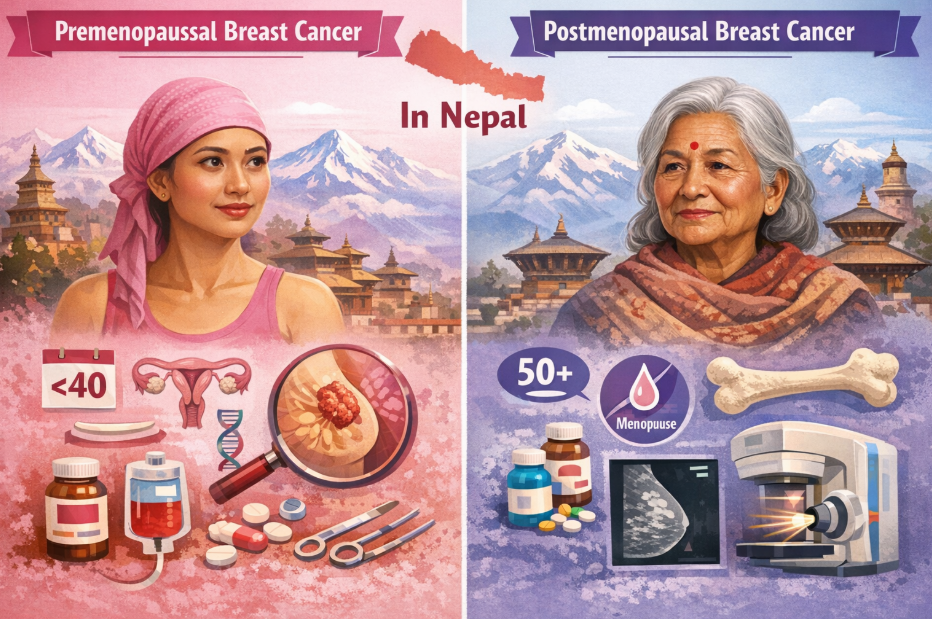
A useful way to think about it is this: menopausal status does not replace cancer staging or tumor subtype, but it does shape risk patterns and treatment choices. In hormone receptor-positive disease especially, menopausal status can change the choice of endocrine therapy, whether ovarian suppression is needed, and how long treatment may continue.
Why menopausal status matters in breast cancer
Menopause changes the body’s hormonal environment. Before menopause, the ovaries are the main source of estrogen. After menopause, estrogen levels fall substantially, and the body produces smaller amounts through peripheral conversion in fat and other tissues. That shift affects both breast cancer risk patterns and treatment strategy, especially for estrogen receptor-positive cancers. Tamoxifen can be used in both premenopausal and postmenopausal women, while aromatase inhibitors are generally used in postmenopausal women unless ovarian function is medically suppressed.
In Nepal, this matters even more because the average age of menopause has been reported around 48.7 years in a large Nepalese study. That means a meaningful number of breast cancer patients present in a biologic transition window where menstrual history, ovarian activity, and endocrine planning all require careful interpretation.
Direct takeaway
- Premenopausal breast cancer often raises issues of fertility, ovarian function, and more aggressive presentation in younger women.
- Postmenopausal breast cancer is more common overall and often intersects with age, obesity, comorbidities, and long-term endocrine therapy planning.
- The right treatment depends on stage, subtype, receptor status, general health, and menopausal status together.
Premenopausal vs Postmenopausal Breast Cancer: key differences
| Factor | Premenopausal Breast Cancer | Postmenopausal Breast Cancer |
| Typical age | Usually before natural menopause | Usually after menopause |
| Hormonal environment | Ovaries actively produce estrogen | Lower ovarian estrogen; peripheral production dominates |
| Clinical concerns | Fertility preservation, treatment-induced menopause, ovarian suppression | Comorbidities, bone health, cardiovascular risk, long-term endocrine tolerability |
| Endocrine therapy pattern | Tamoxifen often central; ovarian suppression may be added | Aromatase inhibitors commonly used; tamoxifen still relevant in some cases |
| Risk profile emphasis | Family history, BRCA-related suspicion, dense breast tissue, delayed diagnosis in younger women | Age, obesity after menopause, hormone therapy exposure, metabolic risk |
| Presentation | Sometimes biologically more aggressive or found later because routine screening is less common at younger ages | Often detected through symptom review or imaging in older age groups |
| Psychosocial impact | Work, childcare, fertility, body image, early menopause | Independence, chronic disease management, bone and joint symptoms, functional status |
This comparison is useful, but it should not be oversimplified. A 45-year-old with chemotherapy-induced ovarian failure and a 51-year-old with ongoing cycles may require individualized classification. Menopausal status in breast cancer is sometimes defined clinically and sometimes by treatment context.
“In breast cancer, age tells you who the patient is; menopausal status helps tell you how the tumor and the treatment environment may behave.”
Risk differences: what changes before and after menopause?
Risk factors more relevant in premenopausal breast cancer
Premenopausal breast cancer tends to raise suspicion when there is:
- A strong family history of breast or ovarian cancer
- Early-onset breast cancer in relatives
- Possible hereditary syndromes such as BRCA-associated disease
- Long lifetime estrogen exposure patterns such as early menarche
- Delayed childbirth or nulliparity in some cases
- Diagnostic delay because younger women may ignore symptoms or assume a lump is benign
Younger age does not mean low importance. In fact, breast cancer at a young age is often more disruptive because diagnosis arrives during active family, reproductive, and work years.
Risk factors more relevant in postmenopausal breast cancer
After menopause, the risk conversation often shifts toward:
- Increasing age
- Obesity and metabolic dysfunction
- Reduced physical activity
- Alcohol use
- Long-term combined menopausal hormone therapy in some women
- Prior atypical breast lesions or personal breast cancer history
The American Cancer Society notes that combined hormone therapy after menopause increases breast cancer risk, especially with longer use. Postmenopausal obesity also matters because fat tissue becomes a more important source of estrogen after menopause.
Nepal-specific context
In Nepal, one strategic challenge is not only biology but late presentation. Awareness gaps, stigma, travel barriers, and delayed consultation can make a potentially curable cancer harder to treat. That is why any persistent lump, nipple change, skin dimpling, or underarm swelling deserves prompt evaluation by a breast cancer doctor or breast cancer specialist in Nepal. Breast cancer is the leading female cancer in Nepal, and earlier detection remains one of the strongest opportunities to improve outcomes.
Summary
- Premenopausal risk often raises questions about hereditary disease and delayed recognition.
- Postmenopausal risk is more closely linked to age, adiposity, and hormone exposure.
- In Nepal, delayed diagnosis remains a practical risk multiplier regardless of menopausal status.
Do symptoms differ?
The core symptoms are often the same in both groups:
- A new breast lump
- Underarm lump or swelling
- Nipple discharge, especially if bloody
- Skin dimpling or thickening
- Nipple inversion
- Redness or persistent breast shape change
What differs is often interpretation, not the symptom itself. Younger women may dismiss symptoms as hormonal, while older women may normalize changes as age-related. Both mistakes can delay diagnosis.
“Breast cancer does not wait for the ‘right age’; it follows biology, not assumptions.”
Diagnosis and staging in Nepal
Whether breast cancer is premenopausal or postmenopausal, diagnosis should follow a structured pathway. The standard clinical sequence usually includes:
- Clinical breast evaluation
- Imaging such as ultrasound, mammography, or both depending on age and breast density
- Biopsy for tissue diagnosis
- Receptor testing for ER, PR, and HER2
- Staging workup based on tumor size, node status, and spread
Menopausal status becomes most influential after tissue diagnosis, especially when endocrine therapy planning begins. This is where an experienced breast cancer surgeon in Nepal and multidisciplinary oncology team add value: the question is no longer just “Is it cancer?” but also “What type, what stage, and what treatment sequence fits this patient best?”
According to Dr. Kapendra Shekhar Amatya’s official site, he has more than 20 years of surgical oncology experience, with work in major cancer centers including Nepal Cancer Hospital and Research Center, and training exposure in oncoplastic breast surgery. That kind of experience matters because breast cancer care is rarely a one-step decision; it requires careful coordination of surgery, pathology, systemic therapy, and reconstruction planning where appropriate.
Treatment differences between premenopausal and postmenopausal breast cancer
This is where the distinction becomes most actionable.
1. Surgery
Surgery is not determined by menopause alone. It depends more on:
- Tumor size
- Location
- Breast-to-tumor ratio
- Node status
- Multifocal disease
- Patient preference
- Reconstruction options
Breast-conserving surgery and mastectomy can both be considered in either premenopausal or postmenopausal patients depending on the case. Oncoplastic planning may improve cosmetic and functional outcomes in selected patients.
2. Chemotherapy
Premenopausal women may receive chemotherapy more often in certain scenarios because younger age sometimes overlaps with higher-risk features, aggressive biology, or the need to reduce recurrence risk. But age alone is not enough; treatment depends on subtype and recurrence risk assessment. Postmenopausal patients may also need chemotherapy when tumor biology or stage warrants it.
3. Endocrine therapy
This is the clearest difference.
In premenopausal breast cancer
Common endocrine approaches include:
- Tamoxifen
- Tamoxifen plus ovarian function suppression
- Aromatase inhibitor plus ovarian suppression in selected higher-risk cases
Because the ovaries are still producing estrogen, simply giving an aromatase inhibitor without ovarian suppression is usually not sufficient.
In postmenopausal breast cancer
Common endocrine approaches include:
- Aromatase inhibitors such as letrozole, anastrozole, or exemestane
- Tamoxifen in selected situations
- Extended endocrine therapy in some higher-risk cases
In postmenopausal women, aromatase inhibitors are frequently central because estrogen production primarily occurs outside the ovaries.
4. Fertility and ovarian function
This issue is mostly concentrated in premenopausal breast cancer. Patients may need discussion about:
- Future pregnancy plans
- Ovarian suppression
- Treatment-induced menopause
- Fertility preservation before systemic therapy starts
That conversation should happen before chemotherapy whenever possible.
5. Bone and menopause-related side effects
Postmenopausal women treated with aromatase inhibitors may need more attention to:
- Bone density
- Fracture risk
- Joint stiffness
- Cardiometabolic health
Premenopausal women placed into ovarian suppression can also develop menopausal symptoms, which makes side-effect counseling essential in both groups.
Section summary
- Menopause changes endocrine therapy planning more than surgical eligibility.
- Premenopausal patients often need ovarian suppression decisions and fertility counseling.
- Postmenopausal patients often need longer-term planning around aromatase inhibitors, bone health, and comorbidities.
What does the best cancer treatment in Nepal look like for these patients?
The best cancer treatment in Nepal is not one hospital name or one surgery. It is a process. High-quality care usually includes:
- Early evaluation by a breast cancer doctor
- Accurate imaging and biopsy
- Pathology with receptor testing
- Multidisciplinary treatment planning
- Appropriate surgery, chemotherapy, radiotherapy, and/or endocrine therapy
- Follow-up focused on recurrence, quality of life, and survivorship
For patients looking for a breast cancer specialist in Nepal, the most useful questions are practical:
- Does the team perform biopsy-guided diagnosis before definitive surgery?
- Are ER, PR, and HER2 routinely evaluated?
- Is breast-conserving surgery offered when appropriate?
- Is reconstruction discussed when mastectomy is needed?
- Is endocrine treatment tailored to menopausal status?
- Is long-term follow-up structured?
That is the difference between treatment that is merely available and treatment that is strategically delivered.
When should a patient in Nepal seek specialist care urgently?

See a breast cancer surgeon in Nepal or breast cancer specialist in Nepal promptly if any of the following are present:
- A new lump lasting more than two to four weeks
- Bloody nipple discharge
- Skin dimpling, ulceration, or nipple inversion
- Enlarged underarm nodes
- A lump that grows after one menstrual cycle
- A strong family history with a new breast symptom
- Any persistent breast change after menopause
This is especially important because many benign breast conditions can mimic cancer, and many cancers initially seem “painless” or “small.” Waiting for pain is not a safe screening strategy.
FAQs: Premenopausal vs Postmenopausal Breast Cancer
1. Is premenopausal breast cancer more aggressive than postmenopausal breast cancer?
Sometimes, but not always. Younger patients can present with more aggressive tumor biology more often, yet the true outlook depends on stage, receptor status, grade, and treatment response, not age alone.
2. What is the main treatment difference between premenopausal and postmenopausal breast cancer?
The biggest treatment difference is endocrine therapy. Premenopausal patients may need tamoxifen and sometimes ovarian suppression, while postmenopausal patients are often candidates for aromatase inhibitors.
3. Can postmenopausal women still get hormone-sensitive breast cancer?
Yes. In fact, many postmenopausal breast cancers are hormone receptor-positive, which is why endocrine therapy is a major part of treatment planning.
4. Does menopause itself cause breast cancer?
No. Menopause does not directly cause breast cancer. But aging, cumulative hormone exposure, body composition, and other risk factors can change after menopause and influence risk.
5. At what age does menopause usually happen in Nepal?
A Nepalese study reported an average menopause age of about 48.7 years, though individual variation is common.
6. Can younger women in Nepal get breast cancer even without family history?
Yes. Family history raises suspicion, but many younger women with breast cancer do not have a known family history. Any persistent lump still needs evaluation.
7. Who should I consult for breast cancer treatment in Nepal?
Patients should ideally consult a breast cancer doctor or breast cancer surgeon in Nepal who works within a multidisciplinary cancer care pathway and can coordinate imaging, biopsy, surgery, pathology, and follow-up.
Conclusion
The most important difference in Premenopausal vs Postmenopausal Breast Cancer is not that one is “serious” and the other is not. Both are serious. The difference is that the hormonal setting, life stage, and treatment pathway change, and those differences affect how smart the treatment plan needs to be.
Key summary points
- Premenopausal breast cancer often demands attention to fertility, ovarian suppression, and younger-age risk patterns.
- Postmenopausal breast cancer more often intersects with aging, obesity, menopausal hormone exposure, and aromatase inhibitor-based planning.
- The best outcomes come from early diagnosis, receptor-based treatment, and multidisciplinary care.
- In Nepal, where breast cancer is the most common female cancer, symptom awareness and timely evaluation remain critical.

For readers seeking context on specialist care, Dr. Kapendra Shekhar Amatya’s official website describes him as a breast cancer surgeon in Nepal with more than 20 years of surgical oncology experience, including breast-conserving and reconstructive-focused practice. In a topic as nuanced as menopausal-status-based breast cancer treatment, experience matters most when it is applied through careful staging, pathology-driven decisions, and individualized care.